
And now it’s your turn: fly the Firebird Duo sequence with me!

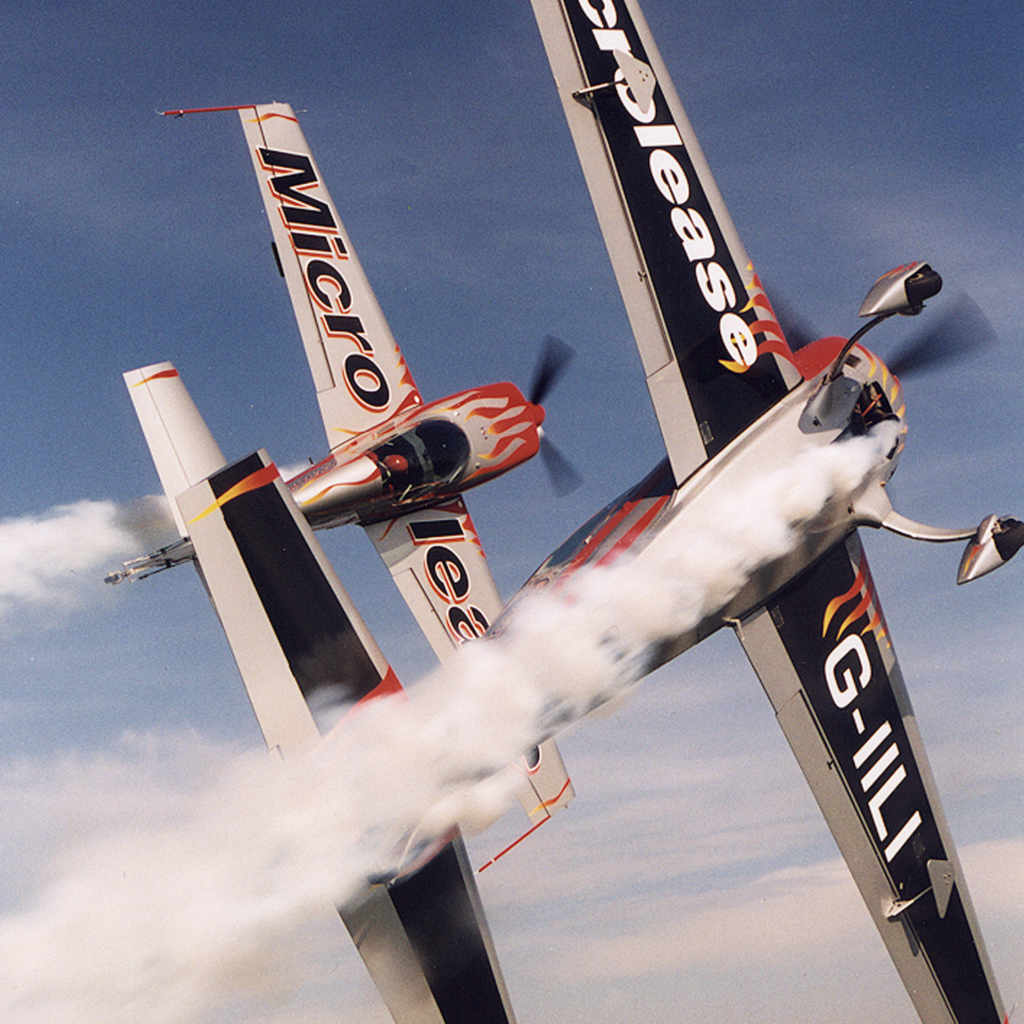
I thought it might be fun to take you all on a full bloodied Duo display with the maestro Brian Lecomber, so fasten your safety harness and enjoy the award-winning sequence we flew in 2001 and 2002.

The whole presentation is designed throughout to have maximum energy and continuous formation changes without turns, wingovers or breathing spaces. It all has to be contained within a 1,000 metre cube of sky with a display base height of 100 feet and to more or less stay below 1,500 feet, a typical European summer cloudbase.

Entry speeds for all figures average 170 knots. In still air you are covering a distance of nearly 90 metres every second. But today you have a 20 knot on-crowd crosswind. Typically a sequence design has one central figure and turnaround figures at each end. You have roughly ten seconds to achieve that with formation changes and co-ordinated rolling elements. All this means is you are very busy and no time to fix position errors – otherwise you disappear into the distance and don’t get invited back!

The plan view of the display looks as if you are cross stitching the airspace but it breaks down to A and B axis at right angles to each other, with the crossing point at dead centre. It’s Brian’s job as leader to work out the start and finish (entry and exit gates) for each manoeuvre and the hardest ongoing equation required for determining wind drift. This is especially a factor when at the apogee of looping figures or at the top of verticals. It’s not possible to change anything when airspeed is low or close to zero but has to be allowed for quickly when positioning just beforehand.

None of this can be done abruptly either, but with smooth and constantly adjusting changes of direction. Otherwise you can’t follow him. Distances between the aircraft is around three feet lateral and vertical separation, either erect or inverted.

When cloud base allows, you start the tip-in on the B Axis at 2,000 feet. You have full power set whilst Brian is around 85%. This provides a small margin of overtake as mirror looping figures need you to accelerate around a wider pitching radius in order to maintain station. As wingman, flying this complex display requires a highly developed sense of space. All concentration is on the lead aircraft next to you. What the horizon is doing becomes almost irrelevant. But your senses and backside take over subconsciously as a 6 G-load comes on after a VNE dive into the opening vertical S with a half roll at the level inverted. When looking at the Lead left wingtip, this means a half roll right whilst you roll your head around the canopy to lock your position on his right wingtip. That takes less than a second and immediately continue the second part of the loop to the down vertical.

Firebird Duo Sequence

As you pull out going back to the start of the B axis you are in the correct position for a synchronised Stall Turn. The Extra goes better to the left in the cartwheel but Brian must wait for the exact speed before calling “now” for the rudder. It’s crucial to cartwheel at the same speed – you are too close to have convergence at near zero airspeed so you step “below” his wing in the vertical. The idea is to have an escape path in case you cross over, and still have full sight of his underside. It doesn’t show from the audience’s perspective as you are plan view to them at the furthest distance away.

Now you are charging back to the centre point. To keep the dynamic flow the sequence is in four elements for variation; formation, opposition, synchronised and solo. The next four figures are a cross break to opposition vertical rolls and tailslide, coming back to centre point for an opposing aileron roll immediately into half loop. This puts you and Brian in towards each other whilst inverted. The rejoin is achieved with a downward clover leaf recovery, again moving away on the B axis.

The ebb and flow keeps going non-stop, but whilst this is happening remember you have the 20 knot on-crowd wind component. If you didn’t allow for the corrections, you would find yourselves quickly busting the safety distance, or worse, over the audience. This is particularly challenging in the next phase, now back in close formation along the main A Axis and about half way through the display programme.
Firebird 12

One of the signature manoeuvres of the Firebirds Display is the Mirror Loop and Mirror Half Cuban. It won’t surprise you to realise this can be tricky to achieve and needs a lot of practice! To compound the problem, the crosswind is pushing you ever closer to the display line. Brian has discovered he can utilise the necessary subtle roll corrections whilst pulling up and then again on the downstroke of the loop. You need to use surprising amounts of rudder to skid sideways whilst disguising the corrections by keeping your wing level parallel with his, all the time maintaining the same canopy-to-canopy separation. It all looks and feels horribly sideways and cross-controlled and very often you need to call “power” as you are flat out to overcome the increased drag, not to mention the greater pitching distance. It’s enough to do your head in sometimes! But it definitely works and the combined effect of small roll inputs and apparent heading changes makes it seem to the audience as if the wind wasn’t there!

The second half of the programme includes a burst from line abreast at the apogee of a humpty figure. This separates by approximately one third of the display line distance. The following vertical pillar figures are flown inverted. Because of the high entry speeds, you need to use something like -5G to avoid going too far. Again, the rejoins are going away on the B axis – a deliberate method of regaining formation quickly without having to use climbing wingovers and positioning turns. Brian is determined never to use these traditional techniques. It also maintains the rhythm and energy of the whole presentation.

The final two sections of the programme give you the opportunity of a short break as Brian continues with a solo display concluding with a spectacular low level join up. You have to pay attention for the right moment to enter stage right whilst barrel rolling just behind him, finishing with an eight-point roll.

In common with all airshow displays, although hot, sweating and exhausted, the flight isn’t over until landing, shutting down and waving to the appreciative audience. Now you can relax and have an ice cream!

Some warriors who win awards for bravery in battle do so when filled with anger, drink or desperation, and some do so in full and quiet knowledge of the risk that they run. Those are the true heroes, as are these two exceptional people. If you get the chance to witness one of their displays you should seize it with both hands. It could be the sort of performance that you will want to tell your grandchildren about.

Nigel Everett, Pilot Magazine, August 2001